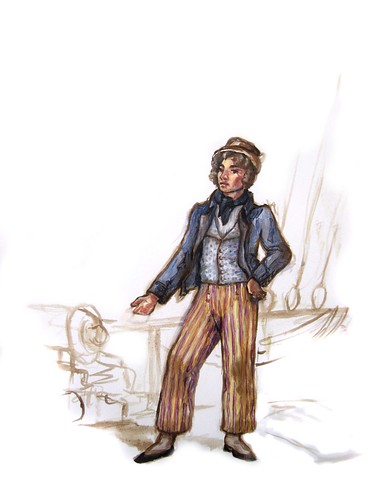
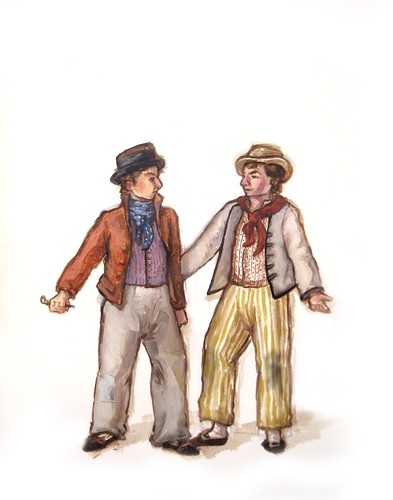
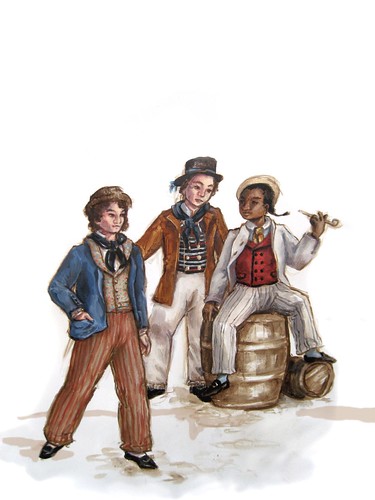
Unless I decide to add backgrounds, the paintings are done.
I worked quite a bit smaller than normal on these, using paper about 12x20 inches large for each piece, with the figures being approximately 6-9 inches tall. That's about the size I normally like to paint faces.
One of the things that had impressed me about the original 1795 ad was how colorful so many of the garments described were. I tried to get that same feeling of color in the paintings without it turning into a circus (though that would have been fun... late 18th cen circus... hmmm). After all, how often do you ever run across yellow, purple, and white striped trousers?
These were all painted on rag paper primed with gesso, and, as per my usual, are done with oil paints.
Tuesday, March 29, 2011
Sunday, March 27, 2011
Common men sketches
When breaking down the list of clothing in the ad from 1795, it was decided to mix and match the garments on a variety of figures. We settled on having six figures total spread across three separate illustrations.
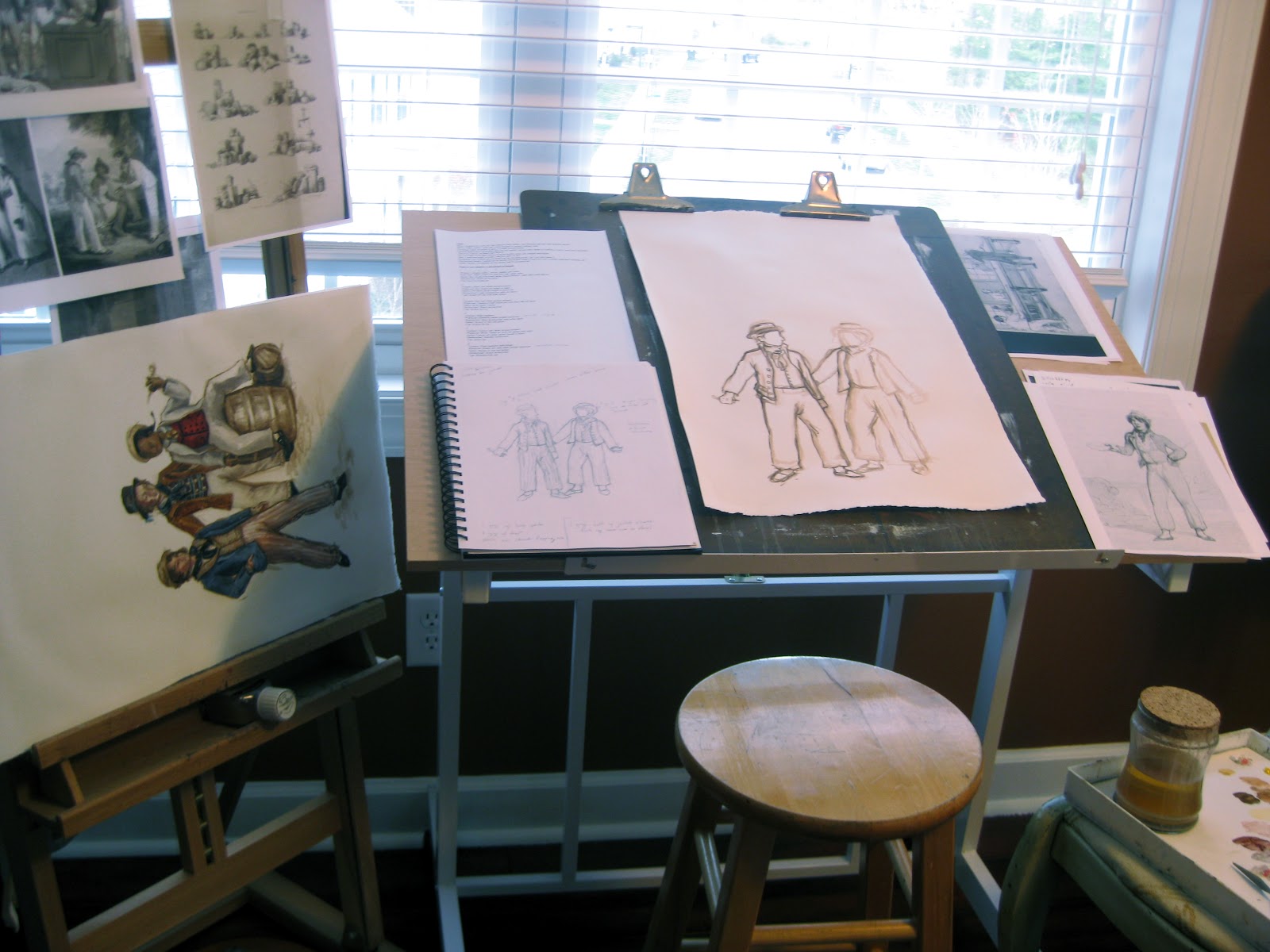
Naturally, the first step of any project is to sketch it in order to work out general composition and provide a point of reference for the painting. Depending on how good my reference images are changes how detailed the sketch is.
I shamelessly ripped off the pose from Thomas Rowlandson's Seaman for this one. As it's in public domain, the only real issue at hand is my oftimes inherent laziness. However, the point of this project is to depict the clothing, not to create pieces of fine art. In this instance (like when doing costume renderings) I'm quite content to cut a few corners.
Once the sketches were approved and changes discussed, it was time for the actual paintings to begin...
Naturally, the first step of any project is to sketch it in order to work out general composition and provide a point of reference for the painting. Depending on how good my reference images are changes how detailed the sketch is.
Once the sketches were approved and changes discussed, it was time for the actual paintings to begin...
Friday, March 25, 2011
At the Mayor's Office- working mens' clothing from 1795
A good friend of mine, Tyler, is currently studying for his masters in material culture at Winterthur, and as part of his thesis is discussing working mens' clothing from the late 18th century. He is looking at a particular advertisement from 1795 which lists a number of clothes that a certain criminal had made off with... ideally, there would be images of these types of clothes to use as a reference in this thesis. Unfortunately, there are not a lot of visual references for working mens' clothes from the time, much less ones which contain the exact items listed.
This is where I, as the artist friend, came in. I agreed to paint several illustration depicting specific articles of clothing mentioned in the ad.
The problem was, I'm not terribly familiar with men's clothing from the 1790s and really didn't want to completely bollocks things up. Fortunately for me, Tyler knows a great deal about the subject (you know, it being the object of his thesis and all...) and he provided me with some prints and drawings of sailors and slaves, plus the original ad in question.
It reads as follows:
"At the Mayor's Office
Are the following articles of Clothing, all new, supposed to have been stolen out of some slop shops or shops. They were found upon a Joseph Lone, a convict who not long hence escaped from gaol - They may be seen by the claimants. Sep. 5, 1795
I pair cotton striped yellow, purple and white trowsers.
3 ditto- yellow and white do.
2 ditto- red and white do.
I ditto- black and white do.
I ditto- plain nankeen do.
I ditto- do with fringe.
2 sailor's jackets, plain nankeen, bound with black silk
I ditto- striped silk
I ditto- plain nankeen
I ditto- Raffia duck, bound with black
I red waistcoat, bound with black
I buff fustian waistcoat, striped yellow and grey
I white waistcoat, with red stripes and spots
I cassimere muff waistcoat, with blue and red spots
I white waistcoat with blue and white spots
I nankeen purple, striped waistcoat
I muslin waistcoat, with red spots
I cotton checked striped shirt
A sheeting bag with a drawing string"
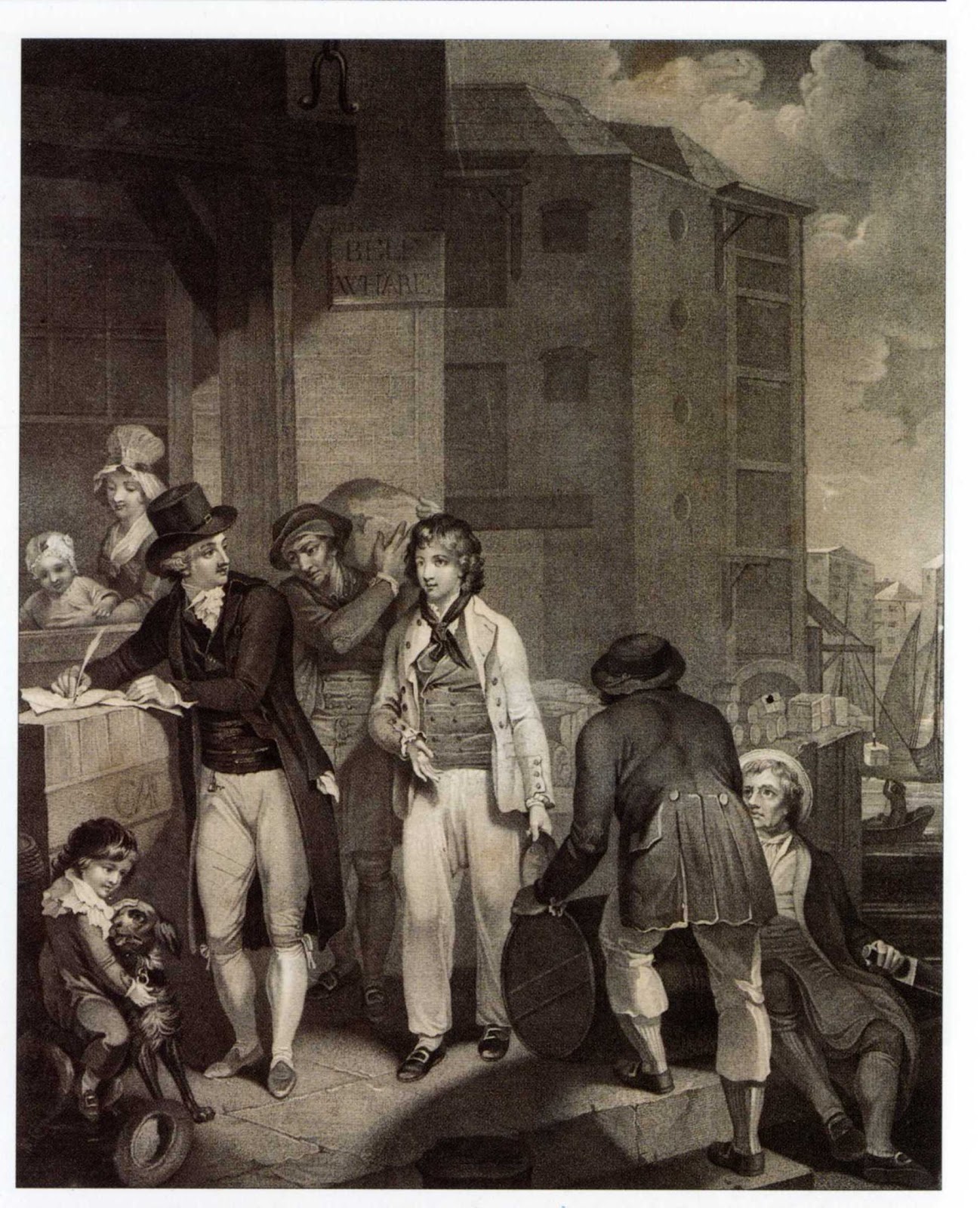
These are the images that Tyler sent me to look at. It's all his research, not mine!
British Plenty by Henry Singleton- 1794
For better or worse, I am basing my illustrations off these images, discussions with Tyler, and what I read in the book The Dress of the People: Everyday Fashion in Eighteenth-Century England. I fully acknowledge that this subject is not my strong point, but as it is, I've already learned a lot from this project. The biggest thing that has jumped out at me so far is the prevalence of striped trousers. Of the nine pairs of trousers listed in the ad, only one pair was completely plain. Seven pairs were striped and one was fringed.
I'd have to look at a lot more ads from the time to really see if striped trousers are that common across the board, or if Joseph Lone happened to steal from a shop owner who was really fond of stripes. But it's interesting nonetheless.
Next up, preliminary sketches and illustration progress...
This is where I, as the artist friend, came in. I agreed to paint several illustration depicting specific articles of clothing mentioned in the ad.
The problem was, I'm not terribly familiar with men's clothing from the 1790s and really didn't want to completely bollocks things up. Fortunately for me, Tyler knows a great deal about the subject (you know, it being the object of his thesis and all...) and he provided me with some prints and drawings of sailors and slaves, plus the original ad in question.
It reads as follows:
"At the Mayor's Office
Are the following articles of Clothing, all new, supposed to have been stolen out of some slop shops or shops. They were found upon a Joseph Lone, a convict who not long hence escaped from gaol - They may be seen by the claimants. Sep. 5, 1795
I pair cotton striped yellow, purple and white trowsers.
3 ditto- yellow and white do.
2 ditto- red and white do.
I ditto- black and white do.
I ditto- plain nankeen do.
I ditto- do with fringe.
2 sailor's jackets, plain nankeen, bound with black silk
I ditto- striped silk
I ditto- plain nankeen
I ditto- Raffia duck, bound with black
I red waistcoat, bound with black
I buff fustian waistcoat, striped yellow and grey
I white waistcoat, with red stripes and spots
I cassimere muff waistcoat, with blue and red spots
I white waistcoat with blue and white spots
I nankeen purple, striped waistcoat
I muslin waistcoat, with red spots
I cotton checked striped shirt
A sheeting bag with a drawing string"
These are the images that Tyler sent me to look at. It's all his research, not mine!
British Plenty by Henry Singleton- 1794
Scarcity in India by Henry Singleton- 1794
Barber scene by Benjamin Henry Latrobe- 1797
Seaman by Thomas Rowlandson- 1798
Industry and Oeconomy by Henry Singleton- 1800
Making a Compass at Sea, London- early 19th Cen.
For better or worse, I am basing my illustrations off these images, discussions with Tyler, and what I read in the book The Dress of the People: Everyday Fashion in Eighteenth-Century England. I fully acknowledge that this subject is not my strong point, but as it is, I've already learned a lot from this project. The biggest thing that has jumped out at me so far is the prevalence of striped trousers. Of the nine pairs of trousers listed in the ad, only one pair was completely plain. Seven pairs were striped and one was fringed.
I'd have to look at a lot more ads from the time to really see if striped trousers are that common across the board, or if Joseph Lone happened to steal from a shop owner who was really fond of stripes. But it's interesting nonetheless.
Next up, preliminary sketches and illustration progress...
Thursday, March 24, 2011
The War of 1812? Say what?
Last weekend my housemate, Nicole, and I spent a couple hours at Military Through the Ages, an annual timeline event at Jamestown. Since it was a timeline event, we had the option of dressing in any era we felt like, and ended up wearing 1812 impressions for comfort reasons and simply because we wanted to.
For me, the 1812 period is kind of a default... after all, I originally started this whole costuming thing because of the Richard Sharpe series and various Jane Austen films. Granted, I know a lot more about English history of the time than American and could tell you more about Napoleon and Wellington and the Peninsular Campaign than I could about the War of 1812, but the general time period, fashions, and aesthetic are resoundingly familiar. Perhaps because of this, I was floored by how many people came up to us at the event and asked us what time period we were from.
Seriously? SERIOUSLY?!
I realize the the War of 1812 is vastly underrepresented in reenacting circles (though things are picking up as the bi-centennial approaches) and that it's almost never talked about in history classes... but one assumes that the general public has at least seen some of the Jane Austen films and could make a connection to that. In fact, 1812 was barely represented at the event, having only one very small group (one, I may add, with NO ladies) which was wedged tightly between much larger Rev War and Civil War units. Even the incredibly niche 1920 IRA group had a larger presence!
On the bright side, all of the good reenactors there (and there were some very impressive groups, including a wonderful 14th century camp that was enough to make me want to go temporarily medieval) knew exactly when we were from. It's really the general public that I was appalled by. Including the woman who called me a "damn yankee" when I said my 1812 group is mostly Michigan based as that's where I'm from. She wasn't joking.
Location might have something to do with it too. 1812 doesn't seem to be nearly as significant in reenacting circles in the south as it is further north... though I haven't yet figured out why.
For me, the 1812 period is kind of a default... after all, I originally started this whole costuming thing because of the Richard Sharpe series and various Jane Austen films. Granted, I know a lot more about English history of the time than American and could tell you more about Napoleon and Wellington and the Peninsular Campaign than I could about the War of 1812, but the general time period, fashions, and aesthetic are resoundingly familiar. Perhaps because of this, I was floored by how many people came up to us at the event and asked us what time period we were from.
Seriously? SERIOUSLY?!
I realize the the War of 1812 is vastly underrepresented in reenacting circles (though things are picking up as the bi-centennial approaches) and that it's almost never talked about in history classes... but one assumes that the general public has at least seen some of the Jane Austen films and could make a connection to that. In fact, 1812 was barely represented at the event, having only one very small group (one, I may add, with NO ladies) which was wedged tightly between much larger Rev War and Civil War units. Even the incredibly niche 1920 IRA group had a larger presence!
On the bright side, all of the good reenactors there (and there were some very impressive groups, including a wonderful 14th century camp that was enough to make me want to go temporarily medieval) knew exactly when we were from. It's really the general public that I was appalled by. Including the woman who called me a "damn yankee" when I said my 1812 group is mostly Michigan based as that's where I'm from. She wasn't joking.
Location might have something to do with it too. 1812 doesn't seem to be nearly as significant in reenacting circles in the south as it is further north... though I haven't yet figured out why.
Saturday, January 1, 2011
1860s Wool Day Dress
A Civil War era day dress of lightweight 'tropical' wool of a slate-like blue-grey color. To trim it I used a narrow, gold colored velvet ribbon, which decorates the bottom edge of the pointed bodice and the sleeves. The assymetrical bodice has domed brass buttons, and a narrow standing band neckline has a white cotton collar basted in. The plaid silk neck bow is totally seperate, and is held on by a brooch. The skirt is triple box pleated and the hem is faced with printed cotton.
Like many of my costumes, I did all visible work by hand and used machine stitching only on interior seams.
I wore this dress to Rememberance Day in Gettysburg two years in a row, and made a small but important change to the dress before wearing it the second time. As you see in the pictures below, the first time I wore this dress I had used black antique buttons on the bodice (which were all I had on hand at the time). The buttons were nice in and of themselves but really did nothing for the gown, and I swapped them out for the plain brass buttons which I think look a great deal better.
The assymetrical, military inspired bodice was quite popular during the Civil War, and is seen in quite a few images from that period. My main inspiration for this dress was the CDV below and I copied the ribbon trim on the sleeves as exactly as I could, though my gown only has one row of ribbon around the waist instead of two.
Friday, December 31, 2010
Monday, August 9, 2010
1800-1810 Cotton Print Dress... and Bonnet!
When planning my hypothetical 1812 wardrobe, one of items on the top of my extensive ‘to do’ list was a serviceable cotton dress in a dark color that could withstand cooking and tearing down camps etc. I made this dress to wear to the annual Siege At Ft. Erie 1812 reenactment in Canada.
Subscribe to:
Posts (Atom)