Monday, April 30, 2012

on paper


I did this little painting a couple months ago as a bit of practice in trying to develop an 18th cen style of painting for portrait miniatures, thinking I should probably give stippling a try since that was a very commonly used technique.

I used a scrap of watercolor paper to paint on... even though ivory was the preferred surface, paper was definitely used at the time as well and has the benefit of being a LOT cheaper (though fittingly, it looks a lot cheaper too).  In fact, one of the coolest ways I've seen miniatures used is one found in 'Napoleon and the Empire of Fashion' which was painted on paper, and stitched into the center of a round silk reticule.  I'd love to make a reticule like that at some point. 

Anyhow, long story short, I think stippling is dreadfully tedious and it's a good thing not all miniature artists used that technique because if I has to stipple every miniature I would loose my mind.  There's a good reason I normally like to work with oils...


Monday, April 9, 2012

An evening in 1912, or, the Epic Titanic Dinner dress


Last weekend I had the very good fortune to attend a truly marvelous, and aptly named, Epic Titanic Party. 

Imagine an evening spent in a pleasant and tastefully decorated home with great company, good conversation, sparkling dresses, lots of champagne, and a mind-blowing and utterly delicious thirteen course dinner.  After the dinner all the guests changed into appropriate 1912 lounge wear, and, well... lounged.  And chatted.  And drank more champagne and absinthe before tumbling into bed.  (I am not too proud to admit that I didn't even get to a bed, but instead crashed right on the floor where I awoke the following morning.)

I can't begin to describe how perfect everything was and can never thank our host, Jenny-Rose, enough for all of her amazing effort in pulling it off so splendidly.

What I can somewhat describe, however, is my dress.

I've always really liked 1912 as a time period and welcomed the excuse to finally make a dress from this era.  I liked nearly every extant dress or illustration or fashion print that I saw, but none of them jumped out as The Dress.  More than any other dress though, I was inspired by this pink one belonging to Queen Maud:


In the end it was easier to not let myself be bound by trying to reproduce a garment, and I eventually simply bought fabric and then fit a design to the materials I had.


The embroidered fabric is an amazing vintage Dupatee which I found on ebay... a purple/burgandy crinkle silk chiffon with gold emboidery and sequins and tiny green and red glass beads.  I then purchased a plain silk chiffon in a matching color, and layered them over a base of congac/paprika/burnt orange silk charmeuse.  Burgandy velvet also decorates the skirt and is used for the bow on the front of the dress.


The charmeuse foundation of the dress is patterned from the 1910 dress in Janet Arnold, and the other layers were simply draped on top.  I can't even begin to imagine trying to flat pattern these sorts of dresses...


I don't really have much to say about my lounging "harem" outfit which followed dinner except that I threw it together the morning of the event, and from start to finish it was done in well under an hour.  Good times...

Sunday, March 18, 2012

Back to the 1860s! Finally, a new dress...

I have finally gotten back to sewing for myself, and have a new silk 1860s gown to show for my efforts!  Last weekend the Mariner's Museum here in Virginia had their 150th anniversary event of the Battle of Hampton Roads (the fight between the Moniter and the Merrimac).  Obviously, I had very little to do with the naval history side of things, but myself and a few other ladies had a display of various sewing and needlework and fashions which we talked about and gave demonstrations of.  It was a long weekend and very exhausting, but quite fun.  It's always so refreshing to be able to do Civil War events every now and then...


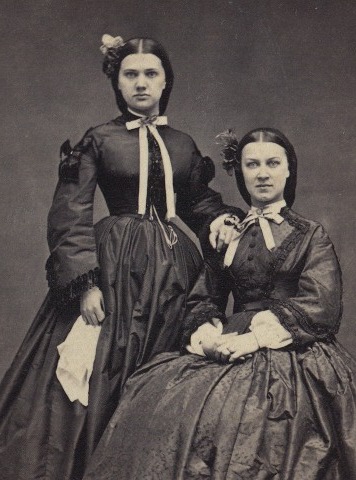
There was a gentleman at the event who was taking tintypes, so the three of us had our image taken together.  I was a little amused that between us we represented three different generations, and had somewhat unintentionally dressed ourselves accordingly.  And I'm always happy to take on the burden of portraying the young, fashionable side of society.  ;)

It's also interesting to me to see how tintypes and period photography really give no real hints toward color at all.  One would never imagine, for instance, that the dress I'm wearing in the tintype is really such a rich, intense blue.


The dress is made of silk taffeta, which languished in my stash for a long time on the grounds that I already had too many blue costumes... but considering I don't wear them all at once, that reason fell apart under the weight of a non-existant budget.  The bodice lining and hem facing are brown polished cotton, and the trim is velvet ribbon.  Hopefully next time this dress appears in public there will be a great deal MORE ribbon on it.  The undersleeves are quite basic, made of white cotton organdy, and are basted into the armscye of the dress.

I also finally got pictures of the sontag I crocheted over a year ago.  This weekend was very chilly, and I was able to put it to good use.  The sontag was really easy to make, and I adapted an 1866 Peterson's pattern which was re-printed in 'Basic Accessories in Knit & Crochet' by Lynne Bury.  The original sontag would have been much too large for what I wanted, and since many patterns from that time say helpful things like 'do a lace pattern of your choice for 3-5 inches' I figured that it was entirely normal to use knitting/crochet patterns as general guidelines rather than the rule.


When I make clothes from the Civil War (or any time period for that matter) I typically fill my computer desktop with a collage of images that I'm drawing the design from, and which I will refer to when making trim decisions or finalizing the pattern.  Naturally I also refer to books, and for this time period I absolutely love 'The Way They Were: Dressed in 1860-1865' and its sequel by Donna Abraham. 

These images are what I had up when making this particular dress, mostly for trim placement and scale of sleeves and bodice points.


I also really love this image of a woman wearing a sontag.  Unlike most sontags you see many reenactors wearing, it's not very large at all and in fact doesn't even wrap around to her back.  The edge at least is clearly crocheted, and the contrasting color is something I considered and used when making my own.


Wednesday, September 14, 2011

no rest for the wicked

I've been super busy recently, having just moved into a (brilliant) new place.  Of course most of the rooms  need to be re-painted and that endeavor is already underway.

The sewing room is still all in pieces, my drafting table won't arrive until tomorrow, and most of my supplies are still languishing in boxes.  I can't wait 'til everything's all together and I can start working on things again!

I thought I'd leave you with this drawing which I started right before moving... it might turn into a painting.  We'll see.


Tuesday, August 23, 2011

A break (of sorts).

I got a decent start on the 1790s gown, but due to issues with my hands/wrists I laid aside all personal sewing projects about a week before the ball and since then have been solely restricting my sewing to work.  Hopefully my hands just need a good rest, and I can get back to my own sewing projects soon.  Lord knows there's a lot on my list!

In the meantime I've been busy finding a new place to live and all the hoop-la that surrounds leasing and moving etc.  In a few weeks I'll be happily ensconced in a lovely little Victorian house with two other girls, and will have a lot of fun re-painting and decorating.  There's a detached garage which I'll eventually turn into an art studio, and I'm really looking forward to setting it all up and working there.

Fortunately, my poor hands aren't half as bothered by drawing as they are by sewing, and I recently finished a charcoal portrait of my friend, Nicole.


Friday, July 22, 2011

Oh, 1797, you kill me with awesome

Next month I will be attending a Jane Austen ball and I must have a new gown for the occasion as it's held in a tavern from the 1790s, and I don't have anything from that period.

After looking at a LOT of fashion plates, I realized that most of the looks I particularly love were from the year 1797.  There's still a lot of crazy layering and some strange experimentation, but things have more or less settled into a stable "look".

I find I'm especially drawn to the style which features an overdress with a cross-over bodice and an asymmetrical skirt.  There were quite a few examples of this style that I ran across, and I've posted my favorites here.  Most of the extant examples of over-dresses from this period that I've seen are made of some sort of colored or pattern fabric with a white (often embroidered) gown or petticoat underneath.  However I was really interested by the 'Afternoon Dress' fashion plate from 1797 which shows a white overdress with a vivid blue petticoat peeking through the asymmetrical opening of the skirt.  Clearly not following the norm.

Evening Dress- Gallery of Fashion, Nov 1795

Afternoon Dresses- Gallery of Fashion, June 1797 

Concert Room Evening Dresses- Gallery of Fashion, April 1797 

The gown on the left of this plate is my absolute favorite of all the ones which I looked at.  I adore the drape of the skirts, the trim, the rich but subtle embroidery of the petticoat underneath... I even like the crazy helmet headdress!

Evening Dress- Gallery of Fashion, June 1797

I sort of mashed up all the elements that I really, really like and combined them in my quick little sketch below.  A gorgeous antique embroidered sari which I bought off ebay will become the petticoat and will also be used for the sleeves.  The over-all color scheme is creamy yellow and white with purple or midnight accents.  And of course there will be an epic headdress with large ostrich plumes dyed at the tips to match the trim on the gown...

Wednesday, July 20, 2011

My Portrait Miniature Experiment

A few days ago I sat down and finished the portrait miniature which I had started a couple months ago.  For being my first attempt I'm somewhat satisfied with it, and I feel like I learned a lot from this experiment.


Watercolor on rolled polymer clay, about 2" x 2.5"

I was mainly focused on trying to learn the technique and get used to the materials and scale of things.  With that in mind, I simply copied from an original in one of my library books:  English Portrait Miniatures.  Sadly, I had to return the book before finishing my miniature OR having the presence of mind to write down pertinent info concerning the artist and subject. 

There are definitely things I want to do differently for the next attempt, most of which relate to tools and materials.  For this first try, I simply used whatever I had on hand, but the student-grade watercolors made my job a lot more difficult.  The white especially... it seemed to 'puddle' on the surface far more than any other color and didn't blend half as well either.  Even if I don't buy any other new paint, I will certainly be investing in a good quality white before my next miniature.

Also on the top of my list are better brushes.  A lot of very small brushes don't have the good flow required for the paint to cling to such a nonabsorbent surface.  I noticed that the same tiny brush which left a good line on paper barely deposited any paint onto polymer clay.  I'm hoping that real squirrel hair brushes (which were used in the 18th cen for such a purpose) will improve things.


My final, and perhaps largest, concern is how to protect the surface.  Even when completely dry, one drop of water would lift the paint right up and and utterly ruin the miniature.  The clay slab is a bit too thick to put under glass with a frame (although that will probably be a possibility for the fake ivory I intend to try at some point soon), so I am trying to find a good spray varnish, intended for watercolor, which will seal the surface.  After all, it would be really pointless to have a miniature that you couldn't even risk taking outside!